-1.png)
When a Break Appears, the Clock Starts
Every operations team knows the moment when T+1 reporting begins and a trade break appears. From there, the investigation starts. Teams begin pulling data from multiple systems, exporting files into spreadsheets, and trying to piece together what went wrong.
Was the trade booked incorrectly? Did the clearing broker report something different? Was there an allocation or average price mismatch?
Most reconciliation processes are built to identify breaks after the fact. By the time a discrepancy appears in T+1 reporting, it may already be affecting margin requirements, operational reporting, or delivery obligations. At that point, the problem is no longer just identifying the issue, but managing its downstream impact.
A more effective approach is to identify and address issues earlier in the trade lifecycle, before they begin to cascade.
Matching Earlier Changes the Process
Traditional reconciliation workflows are inherently reactive. Trades are typically compared overnight, breaks are identified the next day, and only then do operations teams begin investigating issues that may have originated hours earlier, when the relevant context was still fresh.
Matching trades earlier in the workflow changes that dynamic. When discrepancies are identified closer to the point of activity, investigations become more straightforward. The trade is still recent, the context is clearer, and the path to resolution is more direct.
This shift reduces the need to chase aged breaks and allows teams to resolve issues before they impact downstream reporting. As a result, what was previously a reactive process becomes more controlled and predictable.
However, even well-designed processes are tested when conditions change.
When Breaks Start to Compound
During periods of market stress, operational disruption, or broker-side strain, even well-managed T+0 processes may not prevent additional T+1 breaks from appearing. In these situations, the original issue may be temporary, but the operational impact is not.
Brokers can fall behind in processing corrections, and updates may arrive gradually over several days rather than all at once. As a result, reconciliation teams continue to see discrepancies appearing across multiple reporting cycles.
Even after the underlying issue has been resolved and normal processing resumes, teams are often left working through a backlog of aged breaks as counterparties catch up. This is where the real strain emerges—not from the initial discrepancy, but from the accumulation that follows.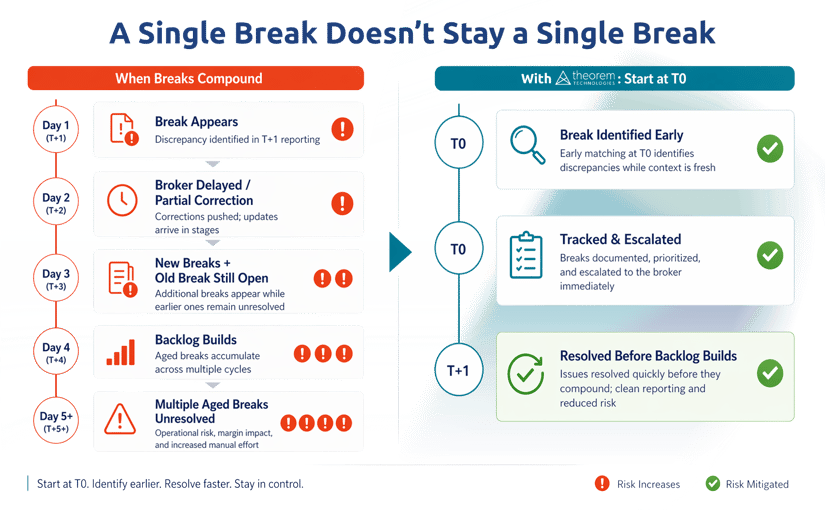
Managing Aged Breaks in Real Time
As breaks begin to accumulate, reconciliation becomes less predictable. Standard workflows give way to revised reports, manual adjustments, and non-standard inputs that do not always align cleanly with existing processes. What was once structured becomes increasingly ad hoc.
In these situations, rigid systems can slow teams down. Operations teams need the flexibility to adapt, to work across changing data inputs, and to trace discrepancies without rebuilding analysis from scratch each time.
Theorem provides that flexibility by allowing teams to run custom matching and investigation queries across any dataset or timeframe. Analysts can isolate aged breaks, compare multiple sources of data, and trace discrepancies back to their root cause within a single environment.
Just as importantly, Theorem operates as both a technology provider and a service partner, supporting clients as they navigate these situations in real time and adjust to evolving conditions.
The Squeaky Wheel Still Matters
Even with the right tools in place, resolution is not automatic. During periods of operational stress, clearing brokers are often managing competing demands, and priorities tend to shift toward what can be processed quickly and what is clearly visible.
In this environment, firms that consistently identify and clearly communicate their discrepancies are more likely to see faster resolution. This is not simply a matter of scale. Even large and sophisticated firms can struggle with aged breaks if issues are not reported clearly and followed up on consistently.
Maintaining visibility into outstanding discrepancies and engaging regularly with brokers becomes critical. Being able to present well-defined, well-supported breaks makes those conversations more effective and increases the likelihood that issues will be addressed promptly.
Technology and Service Working Together
Managing through these periods requires more than just reconciliation tools. It requires experience, transparency, and the ability to adapt as workflows evolve. It also requires support when processes move outside their normal structure.
Theorem is designed to provide both. The platform enables teams to track and investigate discrepancies across any dataset or timeframe, while its service model provides an additional layer of operational support. This includes helping clients navigate communication with counterparties and maintain momentum as they work through aged breaks.
Together, this combination allows firms to remain organized and responsive, even when the operating environment becomes unpredictable.
Stay Ahead of T+ Breaks
Trade breaks are inevitable, but prolonged investigations are not. By identifying discrepancies earlier, maintaining flexible investigation tools, and keeping a clear view of outstanding issues, firms can prevent many T+ problems from becoming extended T+1 challenges.
More importantly, they can stay in control during the periods that matter most—when processes are strained and responsiveness is critical.
Contact Us
If your team is dealing with trade breaks that continue to compound across reporting cycles, Theorem can help.
Contact us to see how flexible reconciliation tools and operational support can help your team track, manage, and resolve T+ issues before they become ongoing T+1 problems.
